How Scalar Energy Works
This page traces the energetic foundations of Tensor Technology across four interconnected domains: Electromagnetism, Quantum Physics, Scalar Energy, and Tensor Fields. Each section builds on the last, guiding you from the familiar physics of oscillating waves through the paradoxes of quantum observation and into the less-charted territory of scalar potential and toroidal field geometry.
Electromagnetism
Electromagnetism is where the journey begins - the domain of physics most familiar from everyday experience, and the necessary baseline for understanding what follows. This section establishes the core vocabulary of waves, frequency, and resonance that the remaining sections will build on and ultimately challenge.
The Foundation of Visible Energy
Electromagnetism is the starting point for understanding how energy moves through space. At its most fundamental level, an electromagnetic (EM) wave is composed of two perpendicular oscillating fields - an Electric Field and a Magnetic Field - traveling together through space at the speed of light.
Every EM wave has three defining characteristics:
- Frequency - the number of complete oscillations per second, measured in Hertz (Hz)
- Wavelength - the physical distance between one wave peak and the next
- Amplitude - the peak intensity or “height” of the wave
The relationship between these three is the cornerstone of classical wave physics: frequency multiplied by wavelength equals the speed of the wave. This means that high-frequency waves have shorter wavelengths, and low-frequency waves stretch across longer distances.
The Electromagnetic Spectrum
The full range of EM frequencies forms the electromagnetic spectrum - from extremely long-wavelength radio waves at one end to ultra-short-wavelength gamma rays at the other. Visible light represents only a narrow slice of this spectrum, the portion our eyes are tuned to perceive.
What makes EM waves so foundational is their transverse nature: the oscillation moves perpendicular to the direction of travel, like the ripple along a rope when you shake one end. This transverse motion radiates outward from a source, diminishing with distance according to the inverse-square law - doubling the distance from a source reduces the field intensity to one-quarter.
Frequency, Oscillation, and Resonance
Every physical object - from a plucked guitar string to a living cell - has a natural resonant frequency at which it oscillates most efficiently. When an incoming wave matches that frequency, the object begins to vibrate in sympathy: this is Resonance. It is the mechanism by which radio antennae receive signals, by which a wine glass shatters at a specific pitch, and - as Our Book explores at length - by which Tensor Rings interact with the body’s own energetic systems.
Understanding electromagnetism provides the essential contrast needed to grasp what makes scalar energy fundamentally different. EM waves radiate, carry energy as a moving transverse field, and obey predictable laws of propagation and decay. Scalar energy, as we will see, behaves by entirely different rules.
Quantum Physics
With electromagnetism as a foundation, quantum physics introduces the first major disruption - a set of experimental discoveries that forced physicists to reconsider what energy, matter, and even observation actually mean. This section covers the principles most directly relevant to subtle energy: particle-wave duality, the observer effect, and the Zero Point Field.
Where Matter Becomes Strange
Classical electromagnetism describes the behavior of energy at human scales. Quantum physics describes what happens at the scale of individual particles - and at that level, the rules change dramatically.
The key insight of quantum physics is that energy does not flow in a continuous stream. It is exchanged in discrete packets called Quanta. This was one of the most disruptive ideas in the history of science: Max Planck and Albert Einstein showed that light, which appeared to be a smooth wave, actually consisted of individual particle-like bundles of energy called photons.
This particle-wave duality - the observation that light and matter behave as both waves and particles depending on how they are measured - is at the heart of quantum mechanics.
The Double-Slit Experiment
One of the most revealing demonstrations of quantum strangeness is the double-slit experiment. When particles (such as photons or electrons) are fired at a barrier with two narrow slits, they produce an interference pattern on a screen behind it - the overlapping waves from each slit create a banded pattern of highs and lows, exactly as water waves would.
This suggests the particle passed through both slits simultaneously as a wave of probability.
But here is where things become extraordinary: when a detector is placed at the slits to observe which path the particle actually takes, the interference pattern disappears. The act of measurement causes the particle to choose a single definite path, and the wave-like distribution collapses.
This is the Observer Effect - the process of conscious observation appears to influence physical reality at the quantum level. Our Book draws on this principle as a foundation for understanding why intention and consciousness are not merely metaphysical concepts, but potentially active participants in the behavior of subtle energy systems.
Uncertainty, Probability, and the Zero Point Field
Quantum mechanics introduces the Heisenberg Uncertainty Principle: the more precisely you know the position of a particle, the less precisely you can know its momentum, and vice versa. This is not a limitation of our instruments - it is a fundamental feature of nature.
This irreducible uncertainty means that even in a perfect vacuum at absolute zero temperature, quantum fluctuations persist. Space is never truly empty. This background sea of fluctuating energy is called the Zero Point Field - a reservoir of potential energy that permeates all of space and that some researchers propose may be the substrate through which scalar energy operates.
Quantum physics thus opens a door: it acknowledges that reality at its finest resolution is probabilistic, observer-sensitive, and suffused with a baseline energetic activity that defies classical description. These qualities will become directly relevant as we move into the nature of scalar energy itself.
Scalar Energy
Scalar energy is where the progression moves beyond conventional physics entirely. Drawing on the vocabulary established in electromagnetism and the anomalies exposed by quantum mechanics, this section describes a class of energetic phenomena that operate by different rules - non-radiating, non-local, and particularly significant in their relationship to living systems.
Beyond Transverse Waves
Scalar energy represents a fundamentally different category of energetic phenomenon. Where electromagnetic waves are transverse - oscillating perpendicular to their direction of travel - scalar energy is described as a longitudinal standing potential: a field of pure energetic pressure or tension that does not radiate in the conventional sense, but instead exists as a stable, non-directional field.
The distinction is best illustrated by analogy. An EM wave is like shaking a rope side-to-side: the motion (the oscillation) travels forward as a transverse wave. A scalar wave is more like pushing and pulling a Slinky along its length: the compression travels forward, but the medium itself moves in the same direction as the wave - a Longitudinal pattern.
This difference in geometry has profound implications for how the wave behaves.
Key Attributes of Scalar Fields
There are several characteristic attributes that distinguish Scalar Fields from conventional EM radiation:
Non-radiating Standing Potential Unlike EM waves that radiate outward and diminish with distance, scalar fields maintain their intensity as a stable standing potential. They are described not as a wave front traveling through space, but as a field pattern distributed throughout a region - more like the tension in a stretched fabric than a ripple on water.
Propagation Without Inverse-Square Loss Nikola Tesla, whose experimental work with longitudinal electrical transmissions observed that his special transmissions did not follow the inverse-square fading that normal EM waves exhibit. He reported that the effect was strongest at the greatest distance - even on the opposite side of the Earth from the transmitter. This behavior directly contradicts classical expectations for radiating energy and hints that scalar fields may operate through a different physical mechanism entirely.
Potential Superluminal Character Some researchers have proposed that scalar fields may not be bound by the speed of light, and may even propagate instantaneously or faster than light - a characteristic sometimes described as superluminal.
Penetration of Physical Barriers Conventional EM fields are blocked or attenuated by physical materials - faraday cages shield electronics from radio waves; dense materials absorb or reflect radiation. Scalar fields are described as passing through matter without loss, unimpeded by conventional material barriers. This would make them analogous in some ways to neutrinos or quantum non-local effects.
Scalar Energy and Living Systems
Particular emphasis must be placed on the relationship between scalar fields and biology. Living organisms are described as highly sensitive resonant systems, and scalar fields are proposed as a medium through which energetic coherence can be established, maintained, or disturbed.
The concept of the Bovis Scale - a measurement system used in subtle energy research - is introduced as one tool for assessing the relative vitality and coherence of a field. Higher Bovis readings indicate a strong, coherent field capable of supporting biological systems and harmonizing with the body’s own energetic architecture.
This framework positions scalar energy not as a curiosity of theoretical physics, but as a practical domain of investigation with measurable, observable effects on living systems - a bridge between the physics of the very small and the lived experience of well-being.
Tensor Fields
Tensor fields bring the progression to its practical conclusion. This section describes how the energetic principles covered in the preceding sections converge in the Tensor Ring - a geometrically precise copper form that generates a stable, self-sustaining field with measurable effects on its environment.
The Geometry of Coherence
Tensor fields represent the practical culmination of this energetic progression. A Tensor Ring - a closed loop of copper wire, twisted and joined at a precise cubit length - is understood to generate a Tensor Field: a stable, self-sustaining energetic geometry that combines properties of scalar potential and toroidal flow.
Understanding tensor fields requires bringing together everything covered in the previous sections. The ring’s structure draws on the electromagnetic properties of copper, the resonant geometry of cubit measurements, the standing potential of scalar fields, and the toroidal topology that appears throughout living systems in nature.
The Energetic Column and Toroidal Flow
When a Tensor Ring is placed flat, it generates two distinct geometric expressions simultaneously:
The Energetic Column A vertical column of energy extends through the center of the ring and outward in both directions along the ring’s axis - a focused, directed stream of scalar potential that runs perpendicular to the plane of the ring. This column is described as highly coherent and capable of influencing the energetic quality of whatever passes through or within its field.
The Toroidal Field Simultaneously, a toroidal (donut-shaped) field wraps around the outside of the ring in a continuous circulation pattern. Energy flows outward from the center of the ring’s plane, curves around the outer edge, and returns through the axis - the same geometry found in the magnetic field of Earth, the vortex of a tornado, and the shape of the human heart’s electromagnetic output. This toroidal flow is self-sustaining and self-organizing, which is why Tensor Fields are described as coherent rather than merely energetically active.
The Role of Cubit Measurements
The specific length of wire used to form a Tensor Ring is not arbitrary. In Tensor Technology, distinct cubit lengths are treated as practical resonant parameters. Each cubit is associated with different field characteristics and use cases - for example grounding, emotional clearing, meditation, space harmonization, water structuring, and much more.
In practice, changing the cubit length changes the ring’s operating behavior. For a concise reference of the cubits, frequencies, and common applications, see our Cubit Measurements page.
Copper as the Conductor of Coherence
Copper is widely regarded as the ideal material for Tensor Rings. Its crystalline atomic structure, exceptional electrical conductivity, and longstanding role in sacred and esoteric traditions across many cultures all contribute to its perceived effectiveness.
Energetically, copper is described as uniquely capable of conducting and amplifying subtle energy fields. When twisted and closed into a ring, the copper wire creates a continuous circuit that captures and stabilizes the scalar potential at its center, allowing the ring to function as a persistent field generator rather than a mere passive shape.
From Theory to Practice
The Tensor Field is where physics, geometry, and consciousness are often viewed as converging. In practical use, Tensor Rings are commonly associated with structuring water, supporting plant growth, harmonizing electromagnetic stress from devices, assisting with pain relief and sleep quality, and supporting meditation and intention work. Through their toroidal geometry, they are also used as physical anchors for coherent energetic environments.
What makes this scientifically interesting is that the mechanism is described as fully consistent with the physics outlined in the preceding sections: EM resonance through copper, quantum field interaction at the boundary of matter, scalar potential sustained through cubit geometry, and toroidal flow as the universal pattern of self-organizing energy systems.
The Tensor Ring is, in this sense, a device that makes the invisible architecture of energy tangible - a physical form through which ancient geometric wisdom and modern subtle energy science become one and the same.
Summary: The Energetic Progression
As we have seen, each section provides the conceptual ground on which the next stands. Electromagnetism reveals the rules of conventional energy. Quantum physics shows where those rules break down. Scalar energy describes a domain that operates beyond those rules. And Tensor Fields show how a precisely constructed geometric form can harness that domain in service of life, healing, and conscious intention.
The table below maps each section to its domain and central principle, offering a compact reference for the conceptual sequence covered on this page.
| Electromagnetism | Classical Physics | Transverse waves, frequency, resonance, inverse-square decay |
| Quantum Physics | Sub-atomic Reality | Wave-particle duality, observer effect, Zero Point Field |
| Scalar Energy | Non-radiating Fields | Standing potential, non-local propagation, biological coherence |
| Tensor Fields | Applied Geometry | Toroidal flow, cubit resonance, copper conductance |
Learn More
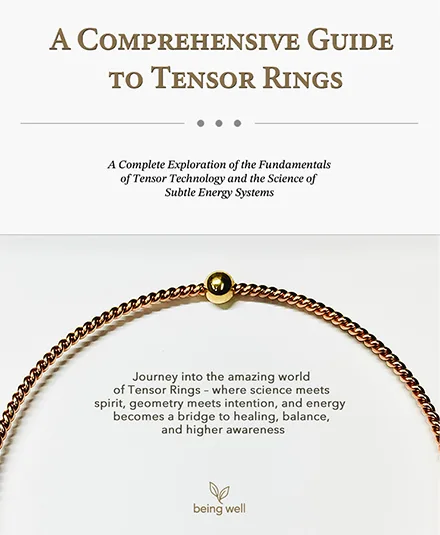
If you want a deeper, extensive, and structured understanding of Tensor Technology, our latest book - A Comprehensive Guide to Tensor Rings goes far beyond the basics!
Within this book we explore the core fundamentals including Electromagnetism, Quantum Physics, Scalar Energy, Tensor Fields, Sacred Geometry, and the role of Intention and Consciousness, alongside the practical craft of physical construction, applications, and the integration of these concepts into daily life.
This book provides the necessary guidance which allows one to connect theory with personal clarity and confidence.
Check it out here!