Sacred Geometry
Sacred Geometry is the study of the proportions and patterns that repeat throughout the natural world - in the spiral of a shell, the branching of a river, a bolt of lightning, the orbits of planets, and the architecture of a single cell. It is not just a way to describe shapes; it is a way of describing how order emerges out of potential, and how that order becomes something physical that we can see, touch, and grow into - the same order that bridges the material and the spiritual planes of existence.
Sacred Geometry treats form and energy as two sides of the same coin: shape guides how energy moves, and moving energy gives rise to shape. The same handful of patterns recur at every scale, from the structure of an atom to the shape of a galaxy, and from the physical body to the subtler planes that surround it, all expressions of a single underlying order that connects the seen world to the unseen one behind it.
A Living Pattern Language
You can find the same geometric relationships showing up again and again in nature - in shells, plants, crystals, and growth spirals. Familiar examples include the Fibonacci sequence, the golden ratio, and circle-based patterns like the Flower of Life.
These patterns are more than symbols. The same proportions that shape a fern frond also shape a spiral galaxy - evidence that the very small and the very large are built from the same instructions, each part echoing the whole. This repetition is the sign that the physical world and the spiritual order behind it are one continuous pattern, expressed at every scale.
At Being Well, we look to these same relationships as a source of order and balance in the tools we create - honoring the pattern itself rather than reducing it to merely just a technical design.
From Unity to Structured Complexity
Geometry often begins with the simplest possible steps: a point, then movement, then a circle. From there, repeating and overlapping circles slowly build into richer, more complex patterns - the same sequence found at the start of biological growth, when a single cell begins to divide.
The point is the simplest form there is - a location with no size or dimension. Think of it as pure potential, a single center of focus before anything else has happened. Every other shape is measured from a point like this one.
The line appears the moment a point moves. A straight path between two points gives us direction and distance - two ends joined by one continuous connection. It’s the first relationship in geometry that we can actually measure, and it’s the foundation for every axis and structure that follows.
The circle forms when a point moves around a fixed center, always staying the same distance away. It’s the first shape that closes in on itself, with every point on its edge sitting an equal distance from the middle. You can see this same shape everywhere in nature - the sun, the ripple from a single raindrop, the boundary of a living cell - each one built from the same principle of wholeness, everything organized evenly around one source. Every pattern below grows out of this one simple shape.
Vesica Piscis
The Vesica Piscis appears when two circles of the same size overlap so that each circle’s center sits on the other’s edge. The almond-shaped overlap that’s created has long symbolized relationship and polarity - the first real interaction between two whole, complete circles.
This same shape is the first thing that appears when a single living cell divides: two overlapping spheres sharing one boundary, the moment one becomes two while still connected at the source. It appears again in the shape of the human eye, in fish and vesica-shaped leaves, and in the almond-shaped halos found in art depicting the meeting of the earthly and the divine.
The Vesica is also useful because its proportions are exact and repeatable. When two equal circles
overlap this way, the height of the overlap always works out to the same fixed ratio - based on
sqrt(3) - and equilateral triangles appear naturally within it. That precision is part of why the
shape recurs so reliably in nature: it’s a stable, low-energy relationship between two centers, the
same balance that lets two distinct things - spirit and matter, self and other - remain whole while
still sharing a common space between them.
Seed of Life
The Seed of Life grows out of that same circle repetition, arranging six circles evenly around one central circle. It mirrors the earliest stages of cellular life: a single fertilized cell dividing again and again until seven cells sit together in this exact configuration - the Seed is, quite literally, the geometry of early biological growth.
This six-fold symmetry recurs constantly in the natural world - the six petals of many flowers, the hexagonal cells of a honeycomb, the six-armed structure of a snowflake. In each case, equal spacing around a center lets complexity grow outward without ever losing balance, every part relating to its neighbors in the same proportion.
The Seed also carries a holographic quality: each of its seven circles is identical in structure to the whole, and each already contains the same relationships found in the larger pattern. That same principle - the whole reflected in every part - carries through the rest of the sequence that follows: the Egg, Flower, and Fruit of Life.
Egg of Life
The Egg of Life is an eight-circle pattern that acts as a bridge between the flat Seed of Life and three-dimensional form. Drawn as circles on a flat page, it is a two-dimensional depiction of eight spheres packed around a shared center in three dimensions - the same underlying structure that later resolves into the Platonic Solids. The pattern points toward organized, three-dimensional space well before the geometry itself becomes a three-dimensional form.
This pattern is also the literal geometry of early embryonic development. After a fertilized cell’s third round of division, it forms exactly eight cells arranged in this same configuration - a stage every organism, human or otherwise, passes through on its way from a single cell to a fully formed body. The Egg of Life is the blueprint every living thing is built from in its earliest moments.
Read this way, the pattern stops being purely symbolic. It shows the same principle at work in embryology as everywhere else in Sacred Geometry: simple, repeating relationships giving rise to increasingly complex, organized structure - the same process by which spirit condenses into matter, and potential into physical form.
Flower of Life
The Flower of Life is a larger web of interlocking circles that shows continuous, harmonious growth. Its repeating structure shows how small, local relationships can extend outward into one large, connected field without ever breaking proportion - the same way a single ripple can spread across an entire pond without losing its shape.
Because every point in the pattern is built the same way, the Flower of Life carries both repetition and order at once - the same self-similarity found in fractals throughout nature: the branching of a tree, the veins of a leaf, the shape of a coastline. Each part echoes the whole, and the whole is made of parts that reflect it back - a holographic relationship where the pattern at any one scale still contains the information of the entire field.
The Flower of Life is a symbol of the underlying unity connecting all living things - the same geometric information expressing itself in the structure of a molecule, an eye, a solar system, and a galaxy. Its strength as a symbol is that it shows the physical world and the spiritual principle behind it as one continuous pattern, expressed at every possible scale.
Fruit of Life
The Fruit of Life distills the Flower of Life down to its essentials - traditionally thirteen circles pulled from the larger pattern. Think of it as the compressed, essential core of everything that came before it, the same way a single seed holds all the information needed to become a full-grown tree.
These thirteen circles are a map of universal creation, connected to the circles of information that underlie the human energy field, and to how consciousness moves from unity into form. The Fruit of Life shows the same principle again: the deepest structure of a thing is its simplest one, with every layer of complexity building back down to a small set of essential relationships.
That same compression shows up throughout biology - a strand of DNA, only a few nanometers wide, contains the complete information needed to build an entire organism. The Fruit of Life offers a geometric parallel: a small, essential pattern of relationships from which much larger, more complex structures unfold.
Metatron’s Cube
Metatron’s Cube appears when you draw straight lines connecting every center point in the Fruit of Life. The result is a dense web of connections traditionally associated with the archangel Metatron, who watches over the flow of energy as it moves from the spiritual realm into physical form.
It is a map of creation itself - a single structure dense enough to hold within it every one of the fundamental building blocks of physical matter, the five Platonic Solids (the Tetrahedron, Hexahedron, Octahedron, Dodecahedron, and Icosahedron). That connection matters because these same solids turn up in the structure of crystals, molecules, and even viruses - Metatron’s Cube is the geometric bridge between an unseen, spiritual order and its expression in physical structure.
Because every line in Metatron’s Cube traces back to the same small set of circle centers, it also carries the same fractal, holographic quality found throughout Sacred Geometry - the whole network of relationships is already present, in miniature, within each smaller cluster of circles. Zooming into any region of the cube reveals the same underlying order found in the whole.
Platonic Solids
The five Platonic Solids are the only shapes of their kind: three-dimensional forms built entirely from one repeating, identical face, meeting at the same angle at every corner - which is why, no matter how you turn them, they always look the same. Each one can be traced directly out of Metatron’s Cube, which is why the two are so often shown together: the cube provides the map of relationships, and the solids are the stable, three-dimensional forms that map resolves into.
Where every pattern before this stays flat, the Platonic Solids are the first shapes in this progression that exist fully in three dimensions. Ancient thinkers paired each one with an element, seeing them as the geometric building blocks from which the physical world itself is assembled. Modern science has found strikingly similar forms recurring at both the smallest and largest scales - in the crystalline structure of minerals, in the protein shells of viruses, and even in models of the underlying structure of space - the same handful of forms echoing from the microscopic to the cosmic.
Tetrahedron
The Tetrahedron is the simplest of the five solids - four triangular faces, six edges, and four corners, with every face touching every other face along a shared edge. It’s also self-dual, meaning its mirror-image counterpart is just another Tetrahedron. There’s no simpler stable shape than this one.
Classically, the Tetrahedron was linked to fire, largely because of its sharp, pointed shape. That same geometry shows up throughout the physical world - it’s the shape carbon atoms form when bonding into methane, and the same angular arrangement recurs in mineral crystal lattices. Metaphysically, it’s treated as the simplest possible container for energy, a natural symbol for concentrated, single-pointed force.
Hexahedron
The Hexahedron - more commonly known as the cube - is built from six square faces meeting at right angles along twelve edges. Its three axes all sit at right angles to each other, making it the most stable and predictable of the five solids.
Classically paired with earth, the Hexahedron is the shape of grounding and containment. That pairing shows up directly in the mineral world - table salt (halite) and pyrite both grow naturally into cubic crystals, their atoms locking into this same right-angled structure. Its stability is why it’s so often used to represent the physical, material plane - the solid ground beneath more fluid, energetic forms.
Octahedron
The Octahedron has eight triangular faces arranged around six corners, and it’s the mirror-image counterpart of the Hexahedron: where the cube has a corner, the Octahedron has the center of a face, and vice versa. That relationship gives it a naturally balanced structure along three separate axes.
Classically associated with air, the Octahedron is a symbol of balance rather than force pointed in one direction. Diamond and fluorite crystals both form naturally into octahedra, and in the subtle body this same eight-faced balance is the heart center - the point where energy moves evenly in every direction rather than favoring one.
Icosahedron
The Icosahedron has the most faces of the five solids - twenty triangles meeting at twelve corners. It’s the mirror-image counterpart of the Dodecahedron, and having so many corners packed closely together gives it a rounder, more fluid silhouette than the other solids, even though it’s built entirely from flat triangles.
Classically tied to water, the Icosahedron’s dense, evenly spread network of corners is a model for flow rather than fixed structure. Many viruses build their protein shells in this same twenty-faced form, and water itself clusters into icosahedral arrangements at the molecular scale - the same shape linking the elemental water of tradition to its literal molecular structure.
Dodecahedron
The Dodecahedron is built from twelve pentagon-shaped faces, making it the only Platonic Solid whose faces aren’t triangles or squares. Because a regular pentagon’s proportions come from the golden ratio, that same ratio, phi, is built directly into this solid’s structure - the same ratio found in pinecones, sunflower seed heads, and the spiral of a nautilus shell.
Classically, the Dodecahedron stood apart from the other four and was associated with aether - the whole that surrounds everything, rather than any single element. Cosmological models describe the dodecahedron as the shape of the universe itself, a fitting echo of its classical role as the form that gives context to the other four.
Merkaba
The Merkaba is two tetrahedra - one point up, one point down - interlocked around a single shared center. It is built from nothing more than the first of the five solids already introduced: the same Tetrahedron, doubled and counter-rotating around one shared axis, one field turning toward the earth and one turning toward the sky.
This exact interpenetrating-tetrahedra form appears directly in mineral crystals. Spinel, magnetite, and diamond all grow into twinned crystals with this same stellated-octahedron structure, two tetrahedra locked through a common center - the Merkaba is not only a symbol, it is a real, recurring crystal habit.
Read at the scale of the body, this same two-tetrahedra field is the classical structure of the human energy field, or light body - one tetrahedron rotating one direction, one the other, meeting at a single center point. The geometry that orders a crystal lattice is the same geometry that orders the subtle body surrounding it, the small structure and the large one built from one identical form.
Like every pattern before it, the Merkaba carries a holographic quality: each of its two component tetrahedra already holds the complete structure of a Platonic Solid on its own, and together they form one larger, self-similar whole. It is the point in this sequence where the physical form of the solids and the spiritual body they generate become literally the same shape, expressed at two different scales at once.
Form, Frequency, and Function
Three principles show up wherever geometry and energy meet in the physical world:
- Proportion: the internal ratios that determine whether resonance settles cleanly, the same ratios found in a seashell’s spiral or a crystal lattice.
- Orientation: the axis and placement that shape how a field moves through space, in the body as much as in a magnetized crystal.
- Coupling: how components relate to each other, deciding whether patterns reinforce or interfere with one another - the same principle behind resonance between two tuning forks.
Cymatics offers a good real-world parallel: apply vibration to matter, and shape appears based on the boundaries it’s moving within. In that same spirit, you can think of geometry as pattern in space, and frequency as pattern in time - two expressions of the same underlying order.
Within Tensor Technology, that gives us a simple guiding principle: shape isn’t decoration, it’s function - a physical expression of coherence, the same coherence Sacred Geometry describes at every scale, from atom to galaxy.
Unity of Source
At a deeper level, Sacred Geometry is more than a description of physical form. It is a map of consciousness - unity expressing itself as multiplicity, then finding its way back to unity through patterns that grow more integrated over time, the same movement from the single point at the start of this page to the fully three-dimensional solids at its end.
Whether you approach it scientifically, biologically, or spiritually, the takeaway stays the same: geometry gives us a clear, physical record of the natural order connecting the smallest part of the universe to the largest, and the seen world to the unseen one behind it.
For a broader foundation in field behavior and application, continue with our Tensor Technology and Cubit Measurements resources.
Learn More
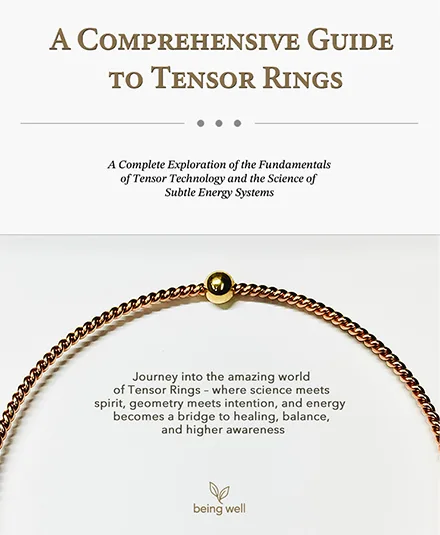
If you want a deeper, extensive, and structured understanding of Sacred Geometry, our latest book - A Comprehensive Guide to Tensor Rings goes far beyond the basics!
Within this book we explore the core fundamentals including Electromagnetism, Quantum Physics, Scalar Energy, Tensor Fields, Sacred Geometry, and the role of Intention and Consciousness, alongside the practical craft of physical construction, applications, and the integration of these concepts into daily life.
This book provides the necessary guidance which allows one to connect theory with personal clarity and confidence.
View A Comprehensive Guide to Tensor Rings on Etsy